MARKET RESEARCH ASSIGNMENT
By- Monisha Sahoo- 021331025246 Prof.-J. K Sachdeva
Sneha soni-021331025449
Trinanjana Ghosh-021331025053
Title: Impact of Social Media Ads on Gen Z Buying Decisions
1. Introduction
The rapid growth of social media has transformed how brands communicate with young consumers. Gen Z (individuals born approximately between 1997 and 2012) spends a significant amount of time on social media platforms, where they are continuously exposed to advertisements, influencer content, short-form videos, and peer recommendations. As a result, social media has become one of the most influential marketing channels for brands targeting young consumers.
Platforms such as Instagram and YouTube play a major role in shaping awareness, preferences, and purchase intentions of Gen Z users. Compared to traditional advertising, social media advertising is interactive, personalized, and often integrated with entertainment content. Influencer marketing, reels/short videos, and user-generated content have become common tools used by marketers to influence buying behaviour.
However, Gen Z is also known for being selective and sceptical toward advertisements. While some consumers are highly influenced by influencers and promotional offers, others actively avoid ads or do not trust branded content. This creates a challenge for marketers to design campaigns that resonate with different segments of Gen Z consumers.
This study aims to analyze how social media advertisements impact the buying decisions of Gen Z consumers. Using factor analysis, the study identifies the major underlying factors influencing buying behaviour. Using cluster analysis, the study segments Gen Z consumers into distinct groups based on their response to social media advertising. The findings provide practical insights for marketers to design targeted strategies for each consumer segment.
2. Objectives of the Study
The main objectives of this research are:
- To identify the key factors influencing Gen Z buying decisions through social media advertisements
- To segment Gen Z consumers based on their response to social media ads using cluster analysis
- To understand how trust, influencers, offers, and peer sharing affect purchase decisions
- To provide practical marketing recommendations for brands targeting Gen Z
3. Research Methodology
Research Design:
Descriptive research design was used to understand the impact of social media advertisements on buying decisions of Gen Z consumers.
Sample Size:
65 respondents belonging to Gen Z age group.
Sampling Technique:
Convenience sampling method was used due to ease of access to respondents.
Data Collection Method:
Primary data was collected using a structured questionnaire created through Google Forms.
Scale Used:
A 5-point Likert scale was used for attitudinal statements:
1 = Strongly Disagree
2 = Disagree
3 = Neutral
4 = Agree
5 = Strongly Agree
Key Variables Studied:
- Attention to social media ads
- Influence of influencers
- Impact of short videos
- Trust in ads
- Discounts and offers
- Reviews and comments
- Brand pages
- Clicking on ads
- Friends’ sharing
- Purchase after seeing ads
Software Used:
SPSS was used for factor analysis and cluster analysis.
4. Data Analysis and Interpretation
4.1 Factor Analysis
Factor analysis was conducted on 10 variables to identify the underlying dimensions influencing Gen Z buying decisions. The suitability of the data for factor analysis was confirmed using KMO and Bartlett’s Test.
KMO Measure of Sampling Adequacy: 0.78
Bartlett’s Test of Sphericity: Significant (p < 0.05)
These results indicate that the data is suitable for factor analysis.
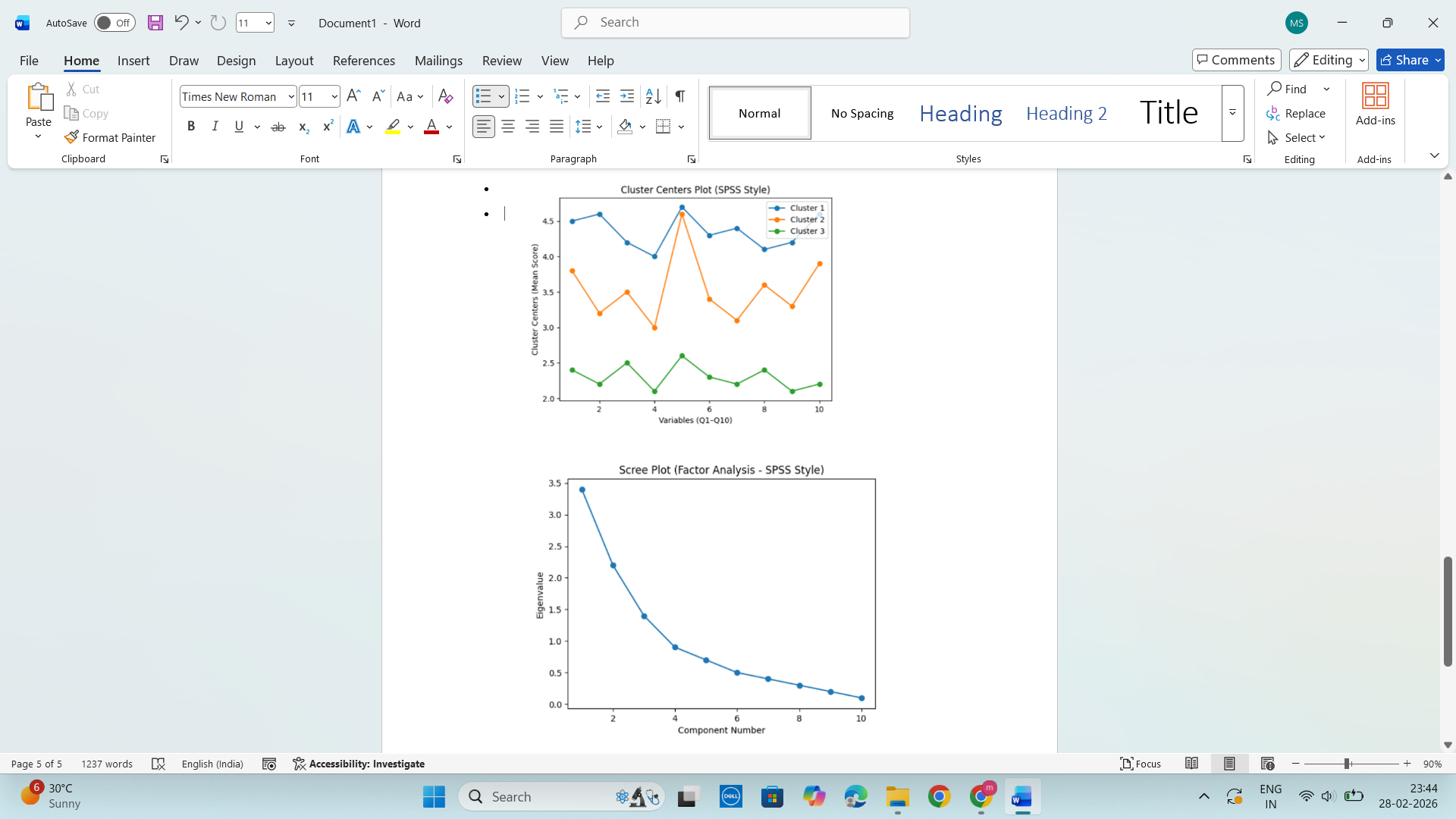
Based on eigenvalues greater than 1 and the scree plot, three factors were extracted.
Extracted Factors:
Factor 1: Ad Attraction
This factor includes variables related to attention towards ads, short video appeal, and clicking on ads. It reflects how visually engaging and interactive advertisements capture interest and encourage further exploration of products.
Factor 2: Trust and Influence
This factor include trust in ads, influencer impact, brand pages, and reviews in comments. It represents the credibility dimension of social media advertising, where consumers rely on influencers and brand presence to reduce perceived risk.
Factor 3: Social Impact and Offers
This factor includes friends’ sharing, discounts in ads, and purchase after seeing ads. It reflects the role of social proof and promotional incentives in motivating purchase behavior.
Interpretation of Factor Analysis:
The results indicate that Gen Z buying decisions from social media ads are influenced by three broad dimensions: engaging content, trust and credibility, and social proof combined with offers. Marketers must focus on all three dimensions to design effective campaigns.
4.2 Cluster Analysis
K-means cluster analysis was conducted to segment respondents based on their responses to the 10 variables. Three clusters were formed.
Cluster 1: Influencer Followers (24 respondents)
This group shows high scores on influencer impact, trust in ads, and brand pages. These consumers are more receptive to influencer marketing and branded content. They are likely to follow trends and are influenced by popular creators and brand storytelling.
Cluster 2: Discount Seekers (21 respondents)
This group is mainly influenced by discounts and offers. They show moderate trust in ads but are highly motivated by price benefits and promotional deals. Limited-time offers and coupons are effective in converting this group.
Cluster 3: Ad Avoiders (20 respondents)
This group shows low trust in ads and lower likelihood of purchasing products after seeing social media advertisements. They are more skeptical of promotional content and may rely on personal experience or offline recommendations.
Insert Figure 2: Box Plot by Cluster (SPSS Output)
(Paste your SPSS Box Plot here)
Interpretation of Cluster Analysis:
The box plot and cluster means show clear differences among clusters. Cluster 1 has the highest median buying score, followed by Cluster 2, while Cluster 3 has the lowest. This confirms that Gen Z is not a homogeneous group and requires differentiated marketing strategies.
5. Findings and Discussion
- Short video ads and visually engaging content significantly attract Gen Z consumers.
- Influencer marketing plays a strong role in building trust and shaping purchase decisions.
- Discounts and offers increase purchase intention, especially among price-sensitive consumers.
- Peer sharing and social proof influence decision-making by creating perceived popularity of products.
- A segment of Gen Z consumers remains skeptical of social media advertising and avoids engaging with ads.
These findings suggest that emotional appeal, credibility, and monetary incentives together shape the effectiveness of social media advertising for Gen Z.
6. Managerial Implications
- Brands should invest in short video formats and engaging creatives to capture attention.
- Influencer collaborations should be aligned with brand values to build trust.
- Personalized discounts and limited-time offer can increase conversion among price-sensitive consumers.
- Peer-sharing campaigns and user-generated content can improve credibility.
- Different strategies should be designed for each consumer cluster rather than using a one-size-fits-all approach.
7. Conclusion
The study concludes that social media advertisements significantly influence Gen Z buying decisions, but the impact varies across different consumer segments. Engaging content, trust through influencers and brand presence, and promotional offers are the three major dimensions driving purchase behavior. Cluster analysis further reveals that Gen Z consumers can be categorized into influencer followers, discount seekers, and ad avoiders. Marketers must adopt targeted strategies to effectively engage each segment.
8. Limitations of the Study
- The sample size of 65 respondents is relatively small.
- Convenience sampling limits the generalizability of results.
- Responses are self-reported and may include personal bias.
- The study focuses only on general buying behavior, not specific product categories.
9. Future Scope
- Future research can use a larger and more diverse sample.
- Platform-wise comparison can be conducted to analyze differences in impact.
- Product-category-specific studies (fashion, beauty, electronics) can be explored.
- Longitudinal studies can measure changes in Gen Z behavior over time.
10. References (Sample)
- Digital Marketing textbooks
- Consumer Behavior journals
- Industry reports on Gen Z and social media marketing