MARKET RESEARCH ASSIGNMENT
By: Ayushi Soni – 21331025093 Prof.- J.K. Sachdeva
Aqsa Siddique – 21331025687
Sourabh Chouhan – 21331025457
A STUDY ON GLOSSOPHOBIA (FEAR OF PUBLIC SPEAKING)
AMONG MBA AND BBA STUDENTS
CHAPTER 1
INTRODUCTION
Public speaking is an essential skill for students pursuing professional and management education. Presentations, group discussions, seminars, and interviews form a core part of academic and professional evaluation. However, many individuals experience intense fear and anxiety while speaking in front of an audience, a condition commonly referred to as Glossophobia.
Glossophobia can negatively impact students’ academic performance, self-confidence, and career growth. Symptoms may include nervousness, increased heart rate, fear of judgment, and avoidance of speaking situations. Despite its prevalence, public speaking anxiety often remains unaddressed within educational institutions.
This study aims to analyze the presence, intensity, and psychological dimensions of glossophobia among MBA and BBA students, and to understand their willingness to improve public speaking skills through training and practice.
CHAPTER 2
REVIEW OF LITERATURE (Brief)
Previous studies suggest that public speaking anxiety is one of the most common social fears among students. Research highlights that factors such as self-confidence, fear of negative evaluation, lack of exposure, and physical symptoms of anxiety significantly affect speaking performance. Literature also emphasizes that structured training, repeated practice, and confidence-building exercises can effectively reduce glossophobia.
CHAPTER 3
RESEARCH METHODOLOGY
3.1 Research Design
The study is descriptive and exploratory in nature, aimed at understanding public speaking anxiety and identifying underlying psychological factors.
3.2 Sample Size
The study was conducted among 50 students pursuing MBA and BBA programs.
3.3 Data Collection Method
Primary data was collected using a structured questionnaire designed through Google Forms.
3.4 Research Instrument
The questionnaire consisted of three sections:
- Section A: Demographic Details
Name, Age, Course/Stream - Section B: Public Speaking Experience
Frequency of public speaking, prior presentation experience - Section C: Glossophobia & Psychological Indicators
Anxiety, fear, physical symptoms, confidence level, belief in improvement, and desire to improve skills
Responses were measured using Likert scale and multiple-choice questions.
3.5 Tools Used for Analysis
- Percentage Analysis
- Factor Analysis
- Cluster Analysis
(Graphical outputs generated in SPSS style)
CHAPTER 4
DATA ANALYSIS & INTERPRETATION
4.1 Demographic Analysis
- Majority of respondents belonged to the 20–23 age group, representing active academic years.
- MBA students formed the largest group (approx. 37.2%), followed by BBA and other undergraduate programs.
- The demographic profile reflects students who are regularly exposed to public speaking situations.
4.2 Descriptive Analysis
4.2.1 Public Speaking Makes Me Anxious (49 Responses)
- 65.3% Agree
- 34.7% Disagree
Interpretation:
A significant majority of respondents experience anxiety while speaking in public, confirming that glossophobia is prevalent among students.
4.2.2 Public Speaking Skills Can Be Improved with Practice (49 Responses)
- 65.3% Agree
- 34.7% Disagree
Interpretation:
Despite anxiety, most students believe improvement is possible, reflecting a positive mindset and openness to learning.
4.2.3 Self-Confidence Plays an Important Role in Effective Speaking (50 Responses)
- 66% Agree
- 22% Disagree
- 12% Neutral
Interpretation:
Most respondents acknowledge the importance of confidence, though a minority underestimate psychological factors in communication.
4.2.4 Desire to Improve Public Speaking Skills (50 Responses)
- 86% Yes
Interpretation:
An overwhelming majority wish to improve their public speaking skills, indicating strong demand for training and development programs.
4.3 Factor Analysis
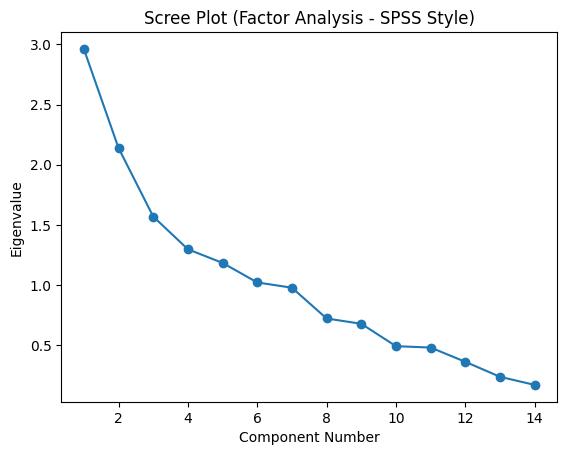
Factor analysis was conducted to identify underlying dimensions of glossophobia.
Scree Plot Interpretation:
- The scree plot shows a clear elbow after the third component.
- Three dominant factors explain most of the variance.
Identified Factors:
- Emotional Anxiety Factor – fear, nervousness, anxiety
- Physical & Cognitive Response Factor – heart rate, fear of judgment
- Confidence & Improvement Orientation Factor – self-confidence, practice, willingness to improve
Interpretation:
Glossophobia is multidimensional, influenced by emotional, physical, and confidence-related factors.
4.4 Cluster Analysis
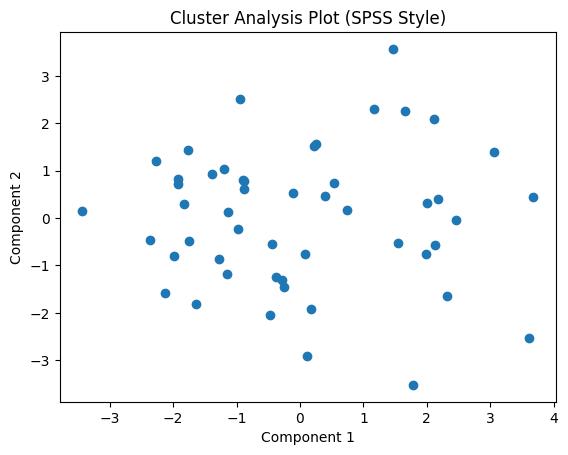
Cluster analysis grouped students based on similarities in anxiety and confidence levels.
Identified Clusters:
- Cluster 1: High Anxiety – Low Confidence Group
- Cluster 2: Moderate Anxiety – Improvement-Oriented Group
Interpretation:
Students differ in intensity and nature of glossophobia, indicating the need for targeted interventions.
CHAPTER 5
FINDINGS
- Glossophobia is prevalent among MBA and BBA students.
- The majority experience anxiety during public speaking.
- Students believe skills can be improved with practice.
- Self-confidence is a critical factor in effective speaking.
- A strong willingness exists for skill improvement programs.
- Students can be segmented into distinct anxiety–confidence groups.
CHAPTER 6
SUGGESTIONS & RECOMMENDATIONS
- Conduct public speaking workshops and seminars.
- Introduce presentation-based assessments gradually.
- Offer confidence-building and personality development programs.
- Provide practice platforms such as debates, role plays, and group discussions.
- Encourage peer feedback and supportive environments.
CHAPTER 7
CONCLUSION
The study concludes that fear of public speaking is a significant psychological concern among management and undergraduate students. While anxiety is common, students demonstrate a positive attitude toward improvement. Factor and cluster analyses confirm that glossophobia is influenced by multiple psychological dimensions and varies across individuals. With appropriate institutional support and training, students can overcome public speaking anxiety and enhance their communication effectiveness.
LIMITATIONS OF THE STUDY
- Limited sample size
- Restricted to one institution
- Responses based on self-perception
- Time constraints
FUTURE SCOPE OF THE STUDY
- Larger and more diverse samples
- Comparative studies across colleges
- Longitudinal studies on training effectiveness
- Inclusion of qualitative interviews